- The Scouting Report
- Posts
- 🏆 Meet the Denver Nugget Built Beyond Basketball
🏆 Meet the Denver Nugget Built Beyond Basketball
Spencer Jones, Professional Basketball Player, Denver Nuggets

Brian Davison
January 13, 2026 • Reading Time: 4 minutes


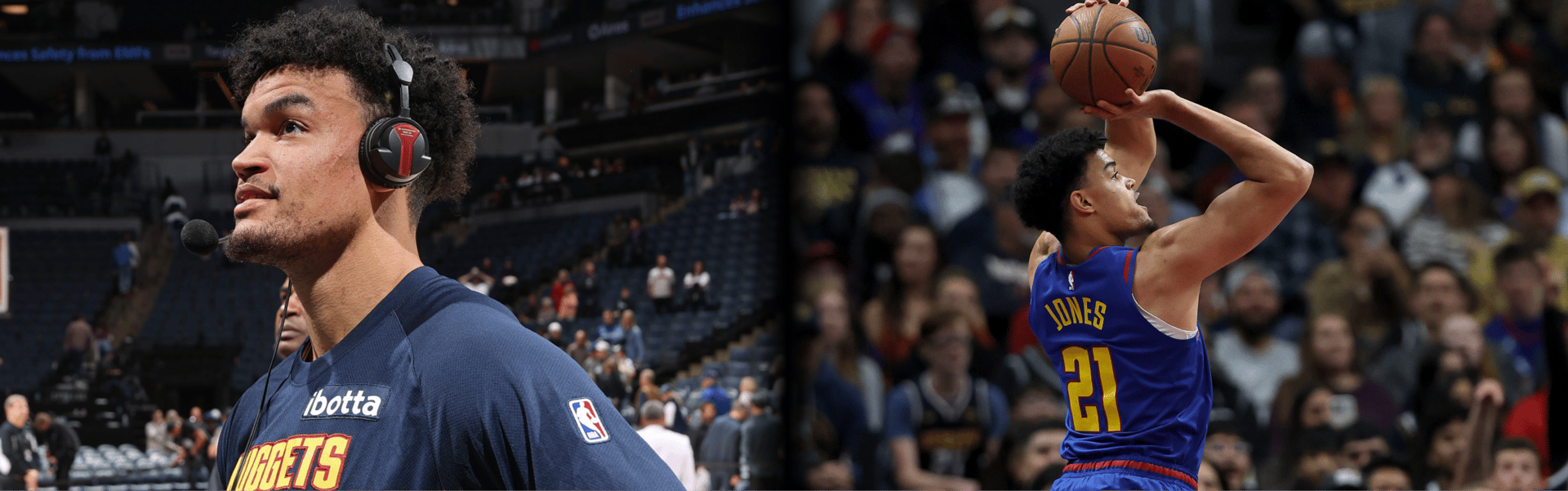
Spencer Jones is a professional basketball player with the Denver Nuggets, currently navigating his NBA career on a two-way contract while earning meaningful rotation minutes. A Stanford graduate with a background in Management Science and Engineering, Spencer is also an active investor and advisor, primarily focused on human performance, health, and wellness companies. Alongside his on-court development, he is intentionally building long-term career optionality through early-stage investing, advisory work, and hands-on involvement with the products and businesses he believes in.
Education First Mindset
Spencer didn’t grow up assuming the NBA would be his destination. In fact, for much of his early life, basketball was secondary to something else entirely: education. “I’ll start with this, the NBA wasn’t really a major thought or something I was really relying on until about halfway through college,” he says. “My dad went to Harvard, so education was the big piece. It was always going to be the main focus.”
That mindset shaped everything that followed. Despite scholarship offers, Spencer still applied to academically elite schools outside of basketball, simply to establish a baseline. “I wasn’t going to sacrifice that for basketball,” he explains. “I’d only take offers if they were better than that.” Stanford became the obvious choice. “You’re not losing anything from any perspective,” he says. “It was better than the Ivies because it was free, a better basketball program, and you’re playing against the best teams while getting a great education.”
Betting on Education, Not the League
At Stanford, Spencer studied Management Science and Engineering, essentially industrial engineering. The NBA was still uncertain. “Agents were talking to me my first two years, but I didn’t really see it as viable until my third year,” he says. Even then, finishing his degree was non-negotiable. “I knew I was going to finish. I was already halfway through,” he says. “I even took a fifth year and had more fun with it.”
That extra year quietly became foundational. Through NIL opportunities, Spencer earned money he didn’t touch. “I didn’t really spend any of it. I just put it away,” he says. “That money let me contribute to my Roth, my 401k, and other investment accounts.” That discipline created optionality. “If all the investing fails, I’m still fine based on that money,” he says. “That allowed me to go into the next phase with confidence.”
Living With Uncertainty
Spencer went undrafted, signed a two-way contract, and entered the NBA knowing how uncertain the situation was. “I know I’m on a two-way, so I can be cut at any moment,” he says. “There’s a high probability you only have this NBA brand for a few years.” Rather than fear that reality, he prepared for it. “Why not maximize it?” he says. “Use the brand and the new capital to build something off the court.” Being around Silicon Valley shaped his thinking. “I was always around startups, VC, and that whole ecosystem,” he explains. “A lot of my friends were building their own things.”
He leaned into health, wellness, and human performance, influenced by both his athletic career and his family background. “My dad’s a doctor, so I always had experience with the health side of things,” he says. “That paired well with me being an athlete.” Most of his early investments reflect that overlap. “A lot of the products I invest in are things I wear or use daily,” he says. “They help me with recovery or my basketball routine, and I give substantial feedback.”
Earning Minutes the Hard Way
On the court, Spencer’s path was anything but linear. “Two-ways are tough,” he says. “You’re bouncing up and down, and most of the time it has nothing to do with how you’re performing.” Real opportunity didn’t come until months into his first season. “Legitimate minutes didn’t come until January or February,” he recalls. “I had no idea what the game plan was. They told me an hour and a half before the game that I was playing twenty minutes.”
That experience clarified everything going into year two. “We have the best offense in the league,” he says. “The only way a young guy is going to get time is defense, energy, doing the dirty work.” So he leaned fully into his role. “I didn’t score a single bucket the entire preseason,” he says, laughing. “I only took like three shots. I focused completely on defense and energy.” That mindset paid off. “I saw myself moving up the roster just off defense,” he says. “Now I’ve started ten, twelve games. It’s been great.”
That readiness has mattered. As the Nuggets navigate injuries and rotation instability on a roster built to contend, Spencer has found himself starting and contributing real minutes in meaningful games. For a team with championship expectations, reliability and defensive presence carry weight, especially when depth is tested. His ability to step in without disruption has been part of how Denver has stayed competitive through that adversity.
Knowing Your Role
Asked what he’d tell a younger Spencer, his answer isn’t about talent. “It’s role recognition,” he says. “I’ve changed my role at every stage of my career. It’s way easier to be the guy who fits any mold than the guy everything revolves around.” The second lesson is mental. “You’re going to be stressed. You’re going to be nervous,” he says. “You just do it anyway. You don’t put so much stake into how you feel.”
That perspective extends beyond basketball. “I feel an obligation to take advantage of where I’m at,” Spencer says. “It would feel like a disservice if the only thing I did was be a basketball player.” For him, the motivation is simple. “There are so many players who want to be where I am,” he says. “And there’s also this question of how good can I personally be. Why not take advantage of it?” Spencer isn’t just navigating a career in the NBA. He’s building a life designed for whatever comes next, with intention, humility, and uncommon clarity for someone still early in the journey.
